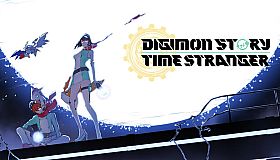







Digimon Story Time Stranger is a single-player turn-based RPG centered on collecting, raising, and battling Digimon across the human world and the Digital World known as Iliad. Players take on the role of an agent investigating anomalies that threaten both realms, building a roster of over 450 Digimon through scanning defeated opponents and converting data into new allies. The experience blends exploration, strategic combat, and deep customization systems that reward careful team building and long-term planning.
Gameplay
The core loop revolves around scanning wild Digimon during encounters to increase their scan rate. Reaching 100 percent allows conversion into a recruitable ally, with higher rates yielding stronger starting stats. Each Digimon possesses one of several attributes in a rock-paper-scissors relationship, primarily Vaccine, Virus, and Data, layered with elemental affinities such as Fire, Water, and Plant. These matchups determine damage multipliers that can reach triple strength or drop to half, forcing players to analyze enemies through repeated attacks before committing to a full strategy.
Combat fields teams of three active Digimon plus a guest companion, with three more held in reserve for mid-battle swaps that do not consume a turn. The protagonist contributes through Cross Arts once a points gauge fills, delivering party-wide buffs, focused damage, or full heals. Speed settings up to five times normal pace and an auto-battle toggle streamline routine fights while preserving manual control for bosses. Personalities assigned to each Digimon influence stat growth, skill acquisition, and available evolution branches, adding layers to training decisions. Attachment skills and equipment further tailor abilities, while a farm system lets unused Digimon gain experience independently.
Exploration spans real-world locations like Shinjuku and Akihabara alongside the vibrant Digital World hub of Central Town. Symbol encounters replace random battles, and a field blaster tool enables preemptive strikes on weaker foes for full rewards without prolonged fights. Evolution paths branch non-linearly, supported by de-digivolution options that reset forms for experimentation. Over time, the systems encourage grinding for stronger evolutions and personality synergies that unlock unique routes.
Game Modes
The primary experience follows a linear story campaign that alternates between investigation segments in the human world and larger expeditions in Iliad. Side missions expand on character backstories and provide additional Digimon encounters or resources. Difficulty options shape the challenge level from the outset, with Story mode reducing enemy damage for a narrative-focused run, Balanced offering standard progression, and Hard increasing enemy stats to demand precise party composition and timing of Cross Arts.
New Game Plus unlocks after the first completion, carrying over scan rates, skills, items, and money while resetting quest progress for a second pass. Additional post-game difficulties become available in this mode, escalating enemy power dramatically and restricting item use or escapes in the highest setting. These options support repeated playthroughs aimed at optimizing teams or tackling tougher variants of existing content without altering the fundamental single-player structure.
Exploration and Progression
Progression ties directly to analysis and collection. Defeating the same species repeatedly refines data on weaknesses, which then informs future team swaps. Agent skills and anomaly points earned through play further customize the protagonist's support options. The personality system creates meaningful differences between duplicate Digimon, turning collection into a strategic pursuit rather than simple completionism. Players experiment with evolution lines across multiple play sessions, using de-digivolution to chase optimal stat distributions or skill sets.
Is It Worth Playing?
Reception has been generally favorable, with critics highlighting the depth of the combat triangle, the satisfaction of non-linear Digivolution, and quality-of-life features like adjustable battle speeds. Some note repetitive dungeon layouts as a drawback, yet the monster-raising loop and strategic preparation keep sessions engaging for players who enjoy deliberate JRPG pacing. The game suits fans of turn-based monster collectors who value attribute management and long-term team optimization over fast action. Current support includes ongoing content additions following the initial release, making it a solid choice for those seeking a substantial single-player campaign with replay value through New Game Plus and difficulty tiers. If strategic battles and creature collection appeal, the title delivers a focused and rewarding experience.