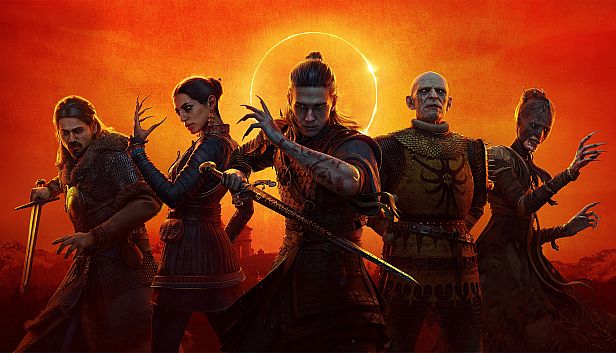



The Blood of Dawnwalker is a single-player open-world action role-playing game set in a fictional 14th-century valley called Vale Sangora in the Carpathian Mountains. Players control Coen, a young man transformed into a Dawnwalker who remains human during daylight hours and gains vampiric traits at night. The central conflict revolves around a 30-day in-game deadline to rescue his family from the vampire lord Brencis, who rules the region after seizing power amid plague and war.
Gameplay
Combat switches between human and vampiric forms based on the time of day. During daylight, Coen relies on swordplay combined with witchcraft and magic abilities. At night, he accesses supernatural skills such as claws, enhanced mobility, and other vampiric powers that allow him to defy gravity or move through the environment in distinctive ways. The game encourages experimentation with these contrasting toolsets, as each form carries distinct strengths and limitations that affect how encounters unfold.
Exploration takes place across a hand-crafted open world featuring forests, plains, swamps, mountains, and medieval settlements. Players discover ruins and remnants of older civilizations while navigating the landscape on foot. Time advances only when the player completes quests or other significant actions, creating a resource-management layer where every choice carries forward momentum toward the deadline. Side activities and alliances can influence the state of the world, though not every opportunity fits within the available window.
Skill progression occurs at wayside shrines that also serve as fast-travel points. Players allocate points across different trees tied to sword combat, witchcraft, and vampiric abilities. The narrative structure supports multiple paths through the story, allowing decisions about whom to assist or confront to shape outcomes without a strictly linear main quest line.
Game Modes
The Blood of Dawnwalker offers a single-player experience with no co-op or multiplayer components. All progression and story advancement occur in one continuous campaign where the day-night cycle and time limit structure player activity. The design emphasizes reactive storytelling, with actions and inactions altering available quests, character relationships, and the broader state of Vale Sangora over the course of the 30 in-game days.
Quest design revolves around a non-linear approach to the central objective of saving Coen's family. Players can rush toward key confrontations or spend time preparing through exploration and alliances, though the advancing clock forces prioritization. This structure replaces traditional difficulty modes or separate campaigns with a unified experience that rewards careful planning around the limited timeframe.
Story and Setting
The game unfolds in an alternate version of 14th-century Europe where vampires have emerged from hiding to claim open rule. Brencis and his followers, known as the Vrakhiri, present themselves as saviors by using their blood to cure the Black Death, in exchange for a blood tax and other demands. Coen begins as an ordinary peasant caught in this regime before his transformation grants him the unique Dawnwalker status that lets him operate in both human and vampire spheres.
Choices throughout the story determine whether Coen fights to retain his humanity or leans into his cursed powers. The world reacts to these decisions through shifting alliances, available support, and the fate of various settlements and characters. Ancient secrets and remnants of prior civilizations add layers to exploration, though the focus remains on the personal stakes of the family rescue mission.
Is It Worth Playing?
The Blood of Dawnwalker launched on September 3, 2026, for PlayStation 5 and other platforms, reaching gold status shortly before release. It has received generally positive reception for its story depth, character writing, and the innovative time and day-night mechanics that create meaningful pressure on player decisions. Reviews highlight the strength of the narrative sandbox and combat variety, while noting some repetition in side content and occasional technical inconsistencies on base hardware.
Players who enjoy choice-driven single-player RPGs with strong writing and a dark fantasy tone will find the core loop engaging. The emphasis on consequences and limited time suits those comfortable with prioritization and replaying sections to explore different paths. Those seeking multiplayer features or lighter tones may find the experience less aligned with their preferences. The game stands as a complete standalone title with no ongoing seasons or updates required for the main campaign.