





Roguebook is a roguelike deckbuilder set within the pages of a living book of legends. Players assemble teams of two heroes and navigate procedurally generated challenges across hexagonal maps while building and refining card decks on the fly. The game emphasizes strategic positioning, synergy between heroes, and adaptation to shifting threats on each run.
Gameplay
Core play revolves around selecting two heroes from available pairs and guiding them through the Roguebook's pages. One hero takes the front position to absorb damage while the other supports from behind, and players can swap their order mid-battle to trigger different abilities and combos. Each hero brings a unique set of cards, a personal relic, and a skill tree that unlocks additional options over multiple runs.
Exploration takes place on hex-based pages that players reveal using magic inks. These inks uncover paths, resources, merchants, quests, and dangers in patterns that change with every attempt. Battles require careful planning of action queues against dozens of enemies and bosses, with over 200 cards available for dynamic deck construction. Relics and upgrade gems further customize strategies, ensuring no two runs play identically.
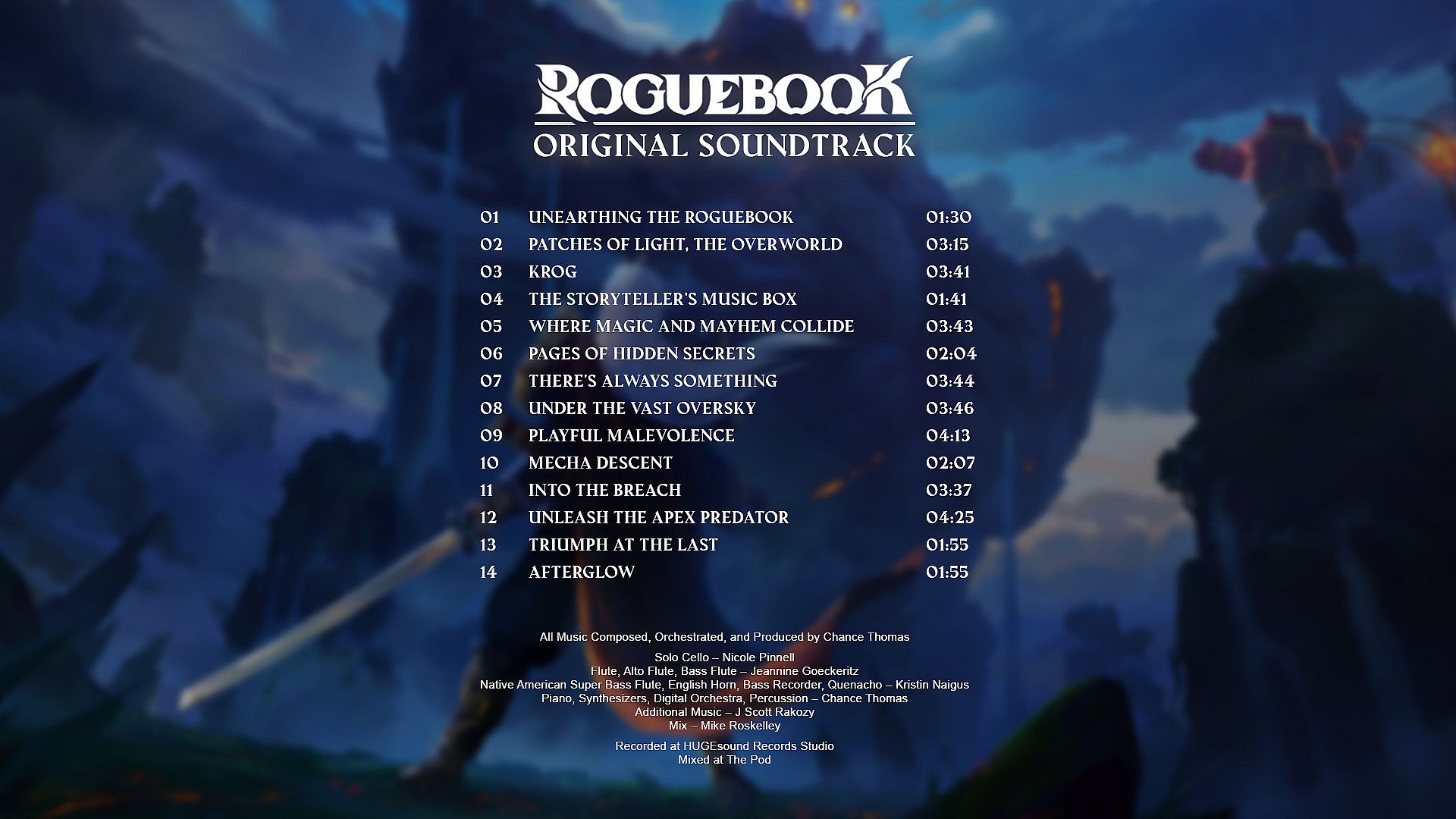
The soundtrack composed by Chance Thomas complements these systems with a live-recorded mix of acoustic instruments including cello, cor anglais, Native American flute, and bass recorder layered over electronic elements. The 14-track album blends dissonance and suggestion to match the mischievous tone, recorded at HUGEsound Records Studio and mixed at The Pod, with contributions from additional musicians on specific instruments.
Game Modes
Roguebook centers on a single-player roguelike campaign structured around runs through the book's pages. Each attempt involves progressing chapter by chapter, defeating bosses to advance, and collecting pages that unlock permanent upgrades between runs. Difficulty scales across 20 levels, with the final boss opening access to an Epilogue mode that introduces tougher enemies alongside new relics and encounters.
Progression ties directly to repeated runs, as collected pages fund hero leveling and new card unlocks. There are no separate competitive or cooperative modes beyond the core roguelike loop, keeping focus on solo experimentation with hero pairs and deck synergies.
Audio and Atmosphere
Chance Thomas handled composition, orchestration, and production for the entire score. The music overlays acoustic performances with electronic textures to create a stark contrast that fits the game's magical yet unpredictable world. Piano, synthesizer, and digital orchestra elements sit alongside the solo cello, flutes, and woodwinds, producing a cohesive backdrop that evolves with the mischievous setting.
Additional music contributions come from J Scott Rakozy, while the live recording approach gives the tracks a tangible presence that stands apart from purely synthetic scores. The result supports both tense battles and exploratory moments without overpowering the strategic focus.
Is It Worth Playing?
Player feedback on Steam rates the game Very Positive based on nearly 2,000 English reviews, with recent reviews maintaining the same overall sentiment. The experience suits fans of deckbuilders who enjoy procedural maps, hero positioning mechanics, and long-term progression through repeated runs. Average playtime to complete the main content sits around 20 hours, with hundreds more available for those chasing full unlocks across all difficulties and hero combinations.
Those seeking a focused single-player roguelike with strong emphasis on card synergies and map painting will find consistent depth here. The title remains actively discussed years after its 2021 release, indicating sustained interest among the genre audience.