



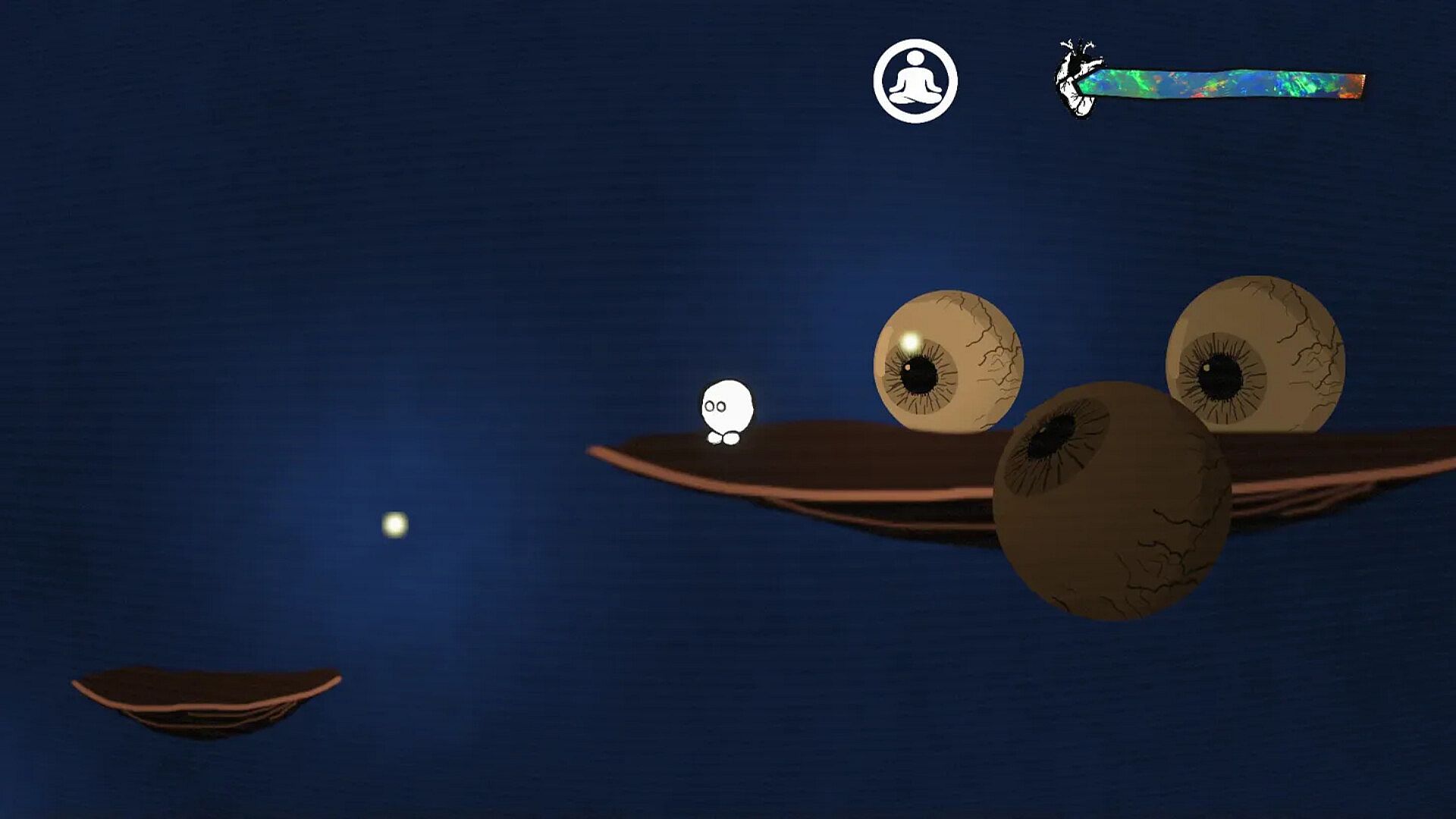
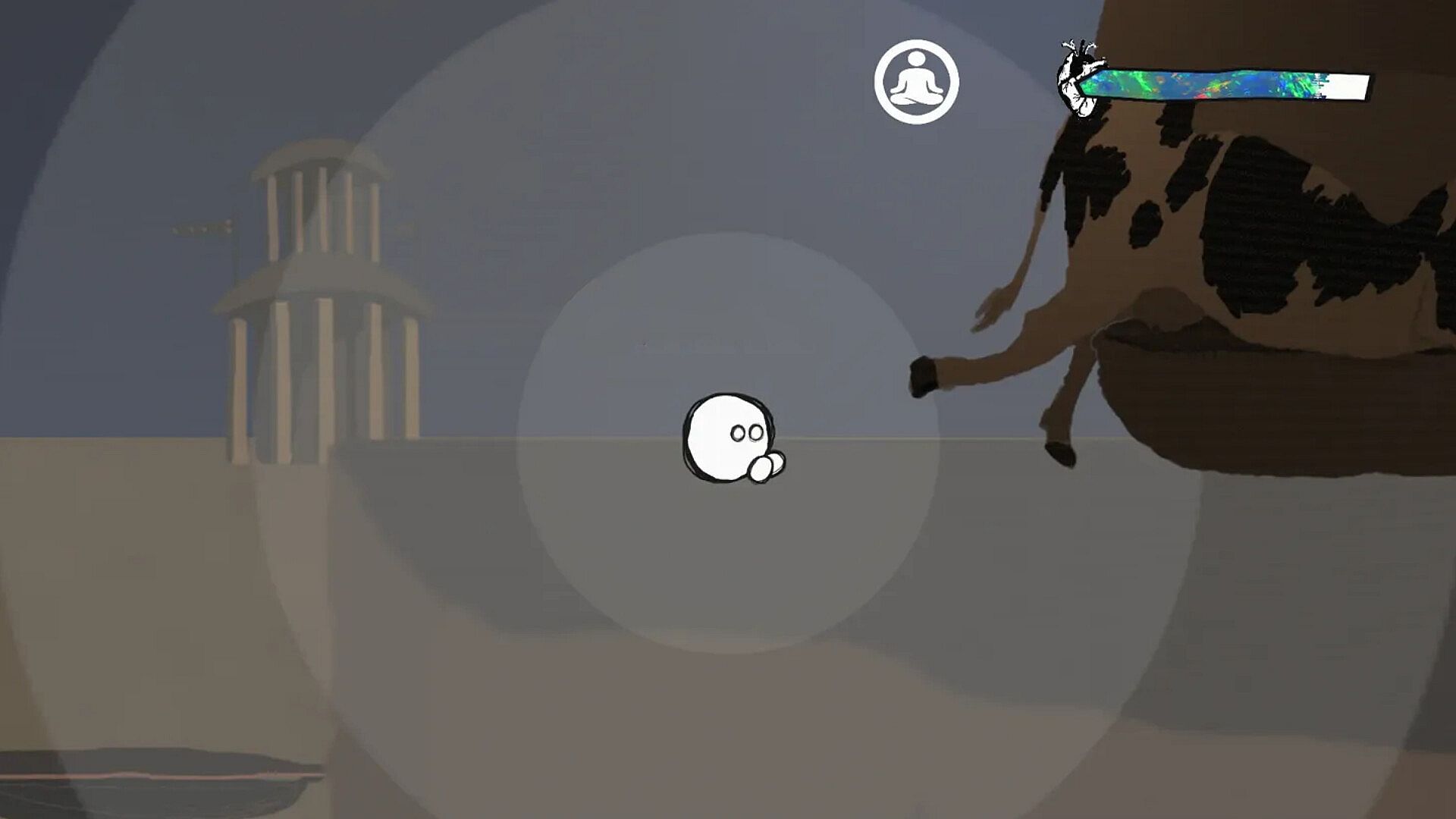

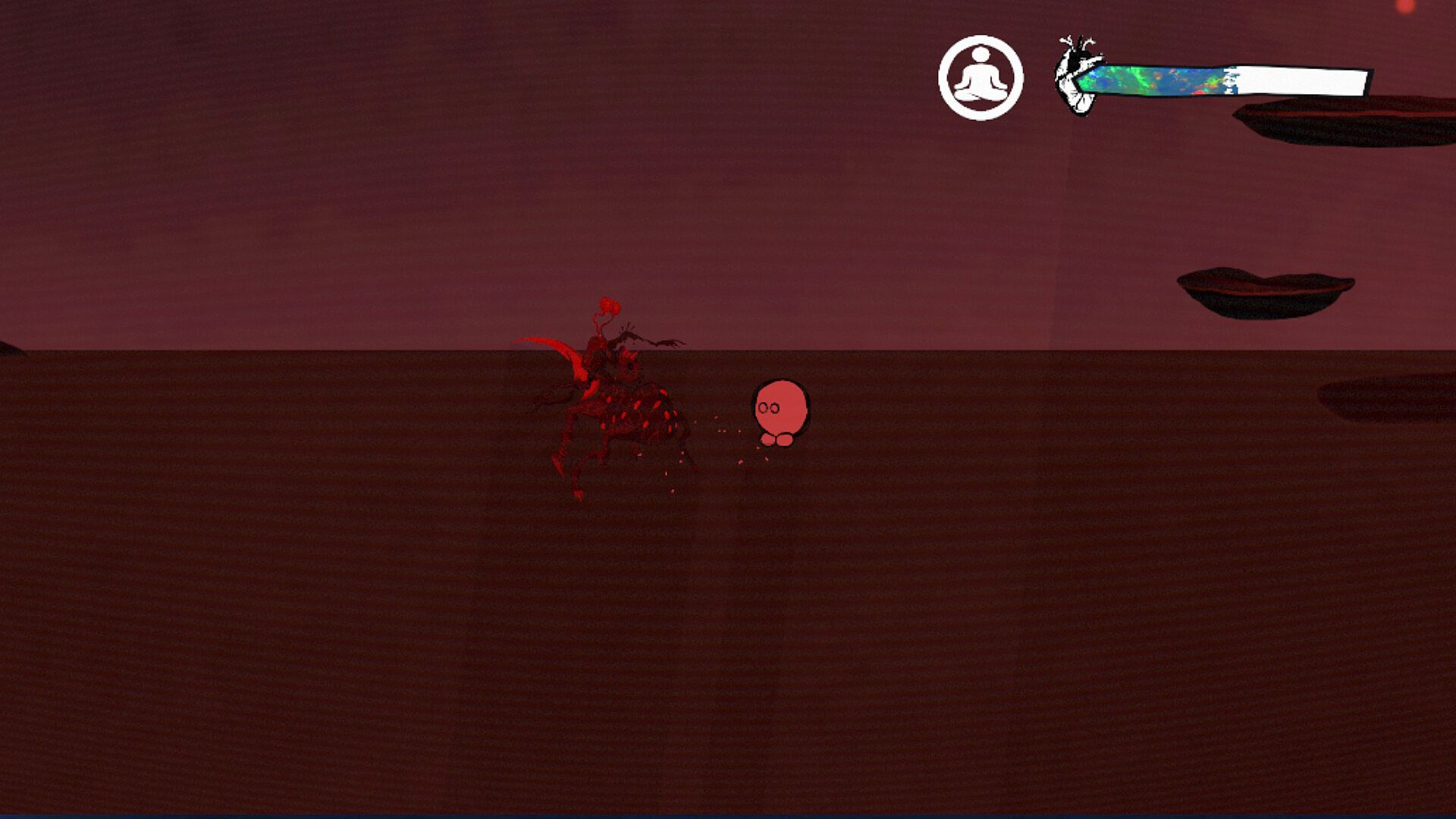





Dig Out is an indie 2D platformer for PC that centers on the protagonist Echo and the way his internal state directly shapes movement, perception, and interaction with the environment. The game unfolds across five acts of philosophical narrative delivered through scattered memory fragments and conversations between Echo and the voice of Augur. Players navigate surrealist landscapes inspired by artists such as Dalí, De Chirico, and Ernst, where emotional pressures manifest as tangible rules rather than abstract themes.
Gameplay
The core loop revolves around managing three Essences that represent mood, vitality, and awareness. These resources deplete over time and whenever creatures make contact with Echo. As the Essences drop, platforming becomes progressively restricted: movement slows, jump height decreases, and the screen darkens to reflect the fading awareness. Recovery requires deliberate meditation actions that pause forward progress but restore some of the lost resources at a measured cost.
Eight distinct enemies each impose a unique movement rule tied to an emotional pressure. One enemy blurs vision, another increases weight and reduces jump reach, a persistent pursuer passes through walls without stopping, and others alternate between visibility states, ranged attacks, escalating threat levels based on player performance, backward pulls, or splitting to surround the character. None of these threats are eliminated through combat. Instead, players alternate two specific buttons to transform each creature into a different form, always expending Essences in the process. The change alters the obstacle without removing its presence from the world.
Memory fragments collected throughout the levels unlock layered dialogue between Echo and Augur. These exchanges reveal fragments of identity and backstory without direct exposition, leaving players to interpret the exchanges. A single decision made at the midpoint alters the tone and available paths for the remaining journey. DualSense controller support assigns distinct haptic patterns to each enemy type, including moments where feedback ceases entirely for a brief interval. The classical soundtrack modulates in intensity and presence according to the current Essence levels, fading or distorting as Echo weakens.
Game Modes
Dig Out supports only single-player progression. There are no competitive, cooperative, or multiplayer modes of any kind. The entire experience consists of a linear sequence of levels divided into five acts, with exploration focused on locating memory fragments and navigating the shifting platforming challenges created by the Essences and enemy behaviors. Progress is saved automatically through Steam Cloud, and achievements track completion milestones and specific transformation choices.
Narrative and Presentation
The story avoids explicit explanations in favor of environmental storytelling and the accumulating weight of Echo's condition. Surreal geometry and a restrained color palette keep attention on the mechanical feedback loop between internal state and external movement. The art direction emphasizes impossible perspectives and symbolic forms that mirror the psychological themes without literal representation. Sound design pairs the adaptive classical score with minimal ambient cues that reinforce isolation and introspection.
Is It Worth Playing?
Dig Out targets players who value deliberate pacing and systems that make emotional states mechanically relevant rather than purely thematic. The single-player structure rewards careful resource management and experimentation with transformations over speed or high scores. Because the game remains in development with no public release date or completed reviews available, any assessment rests on the consistency of its described mechanics and the absence of conflicting information from official sources. Those drawn to narrative platformers that integrate character condition into controls and avoid traditional combat resolution will find the core systems align closely with that interest. The PC version includes full controller support and Steam features such as achievements and cloud saves once the title launches.