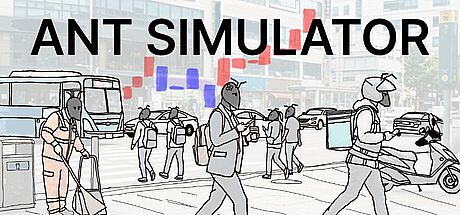



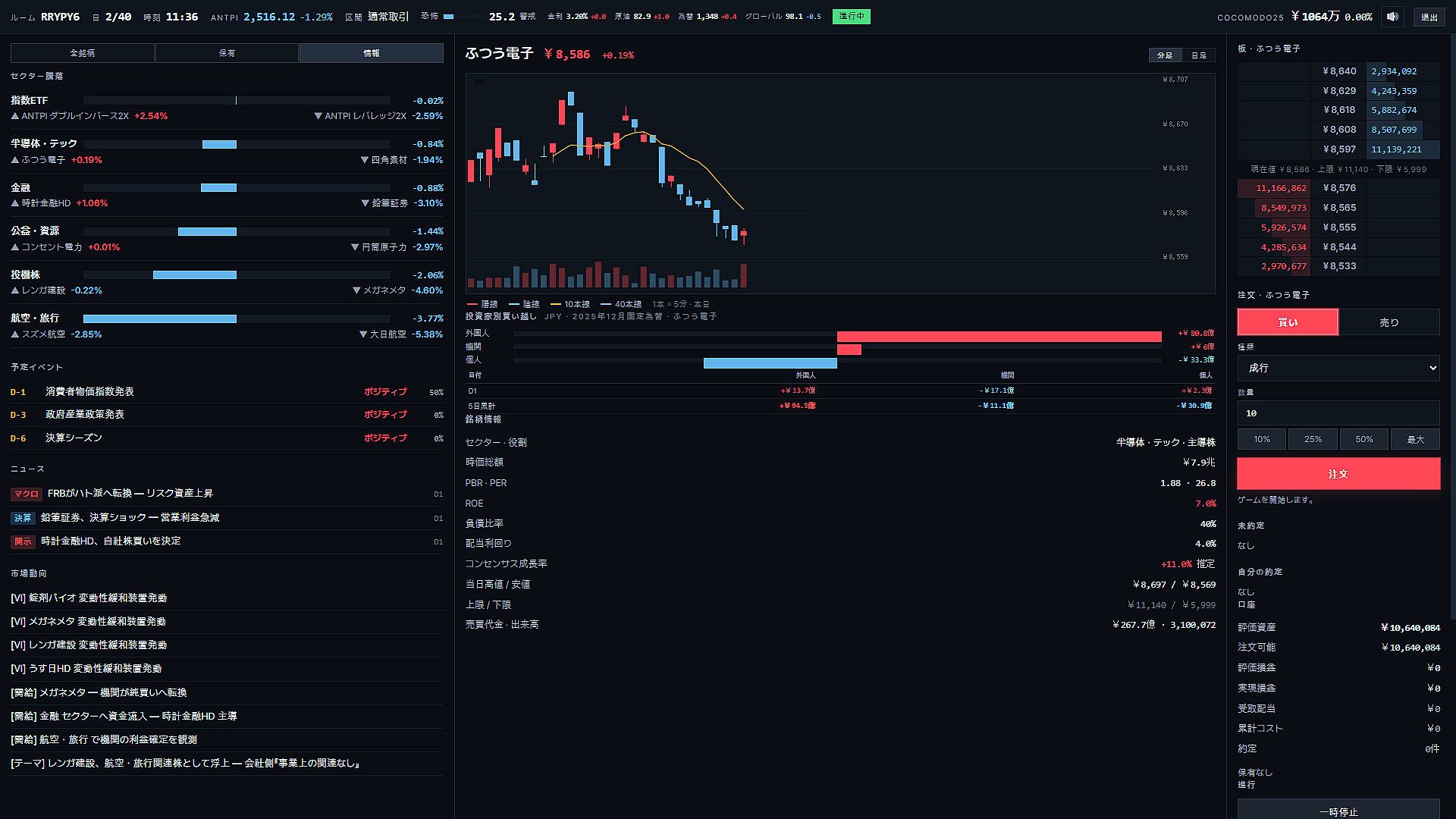
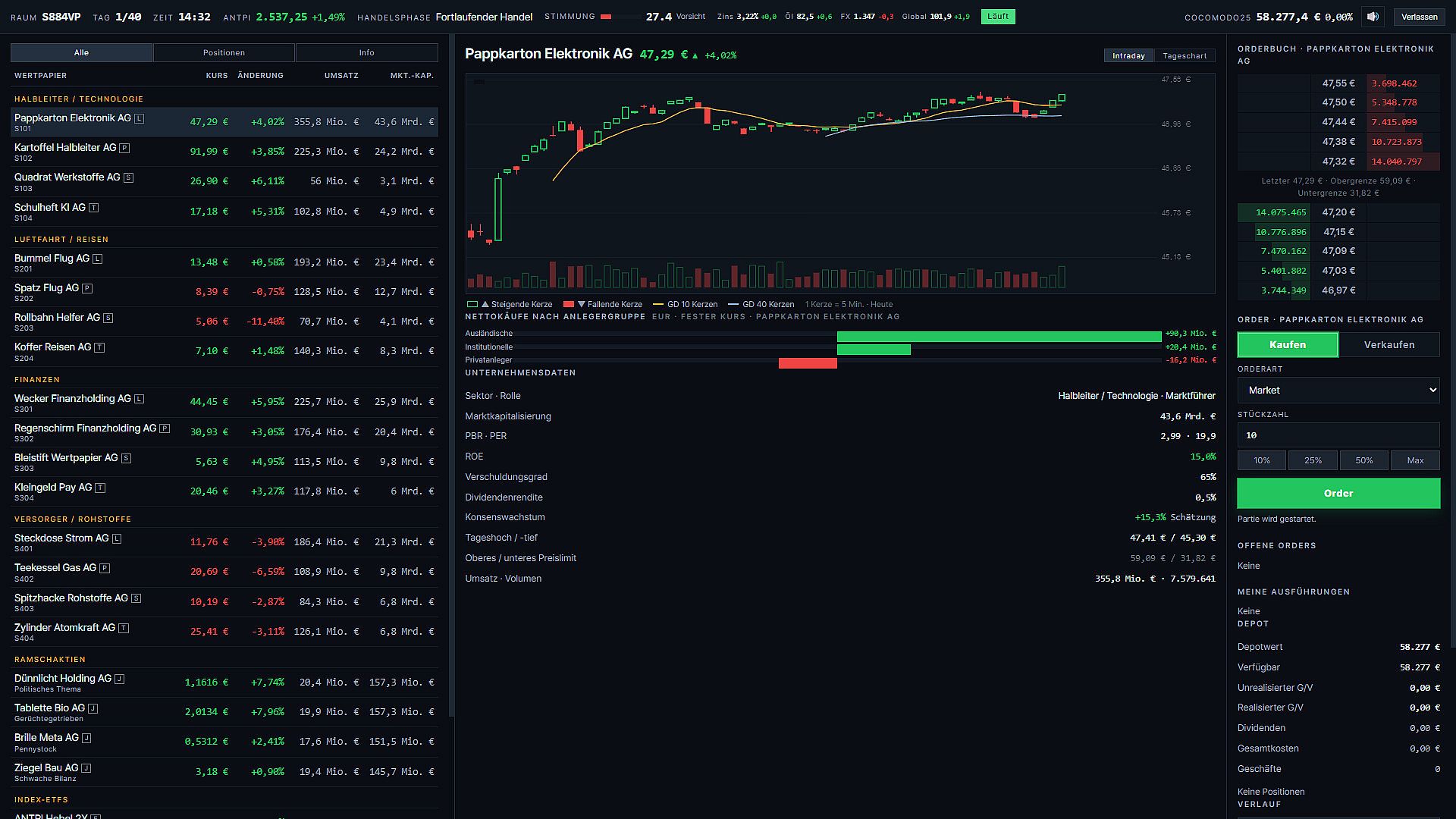
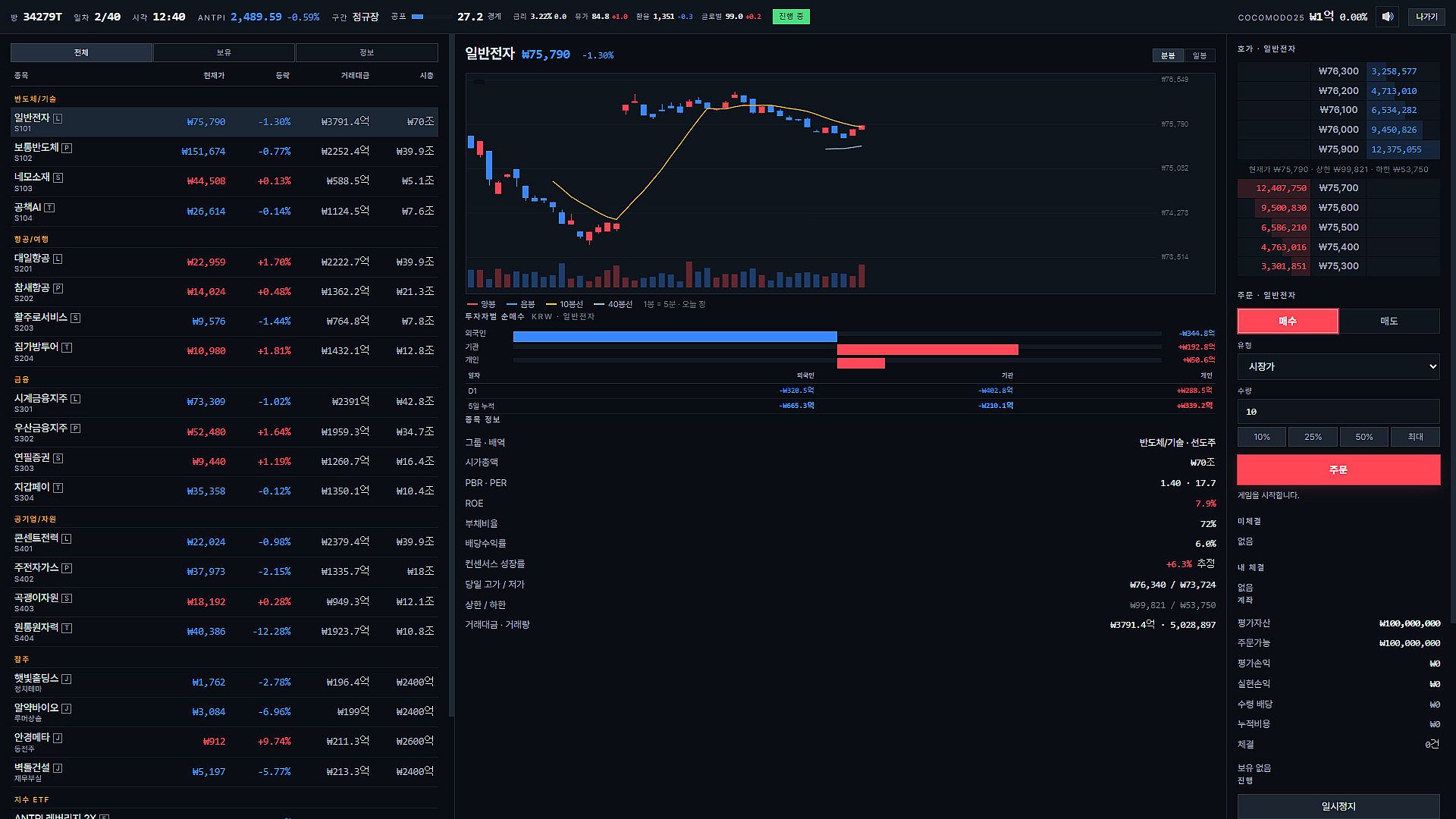
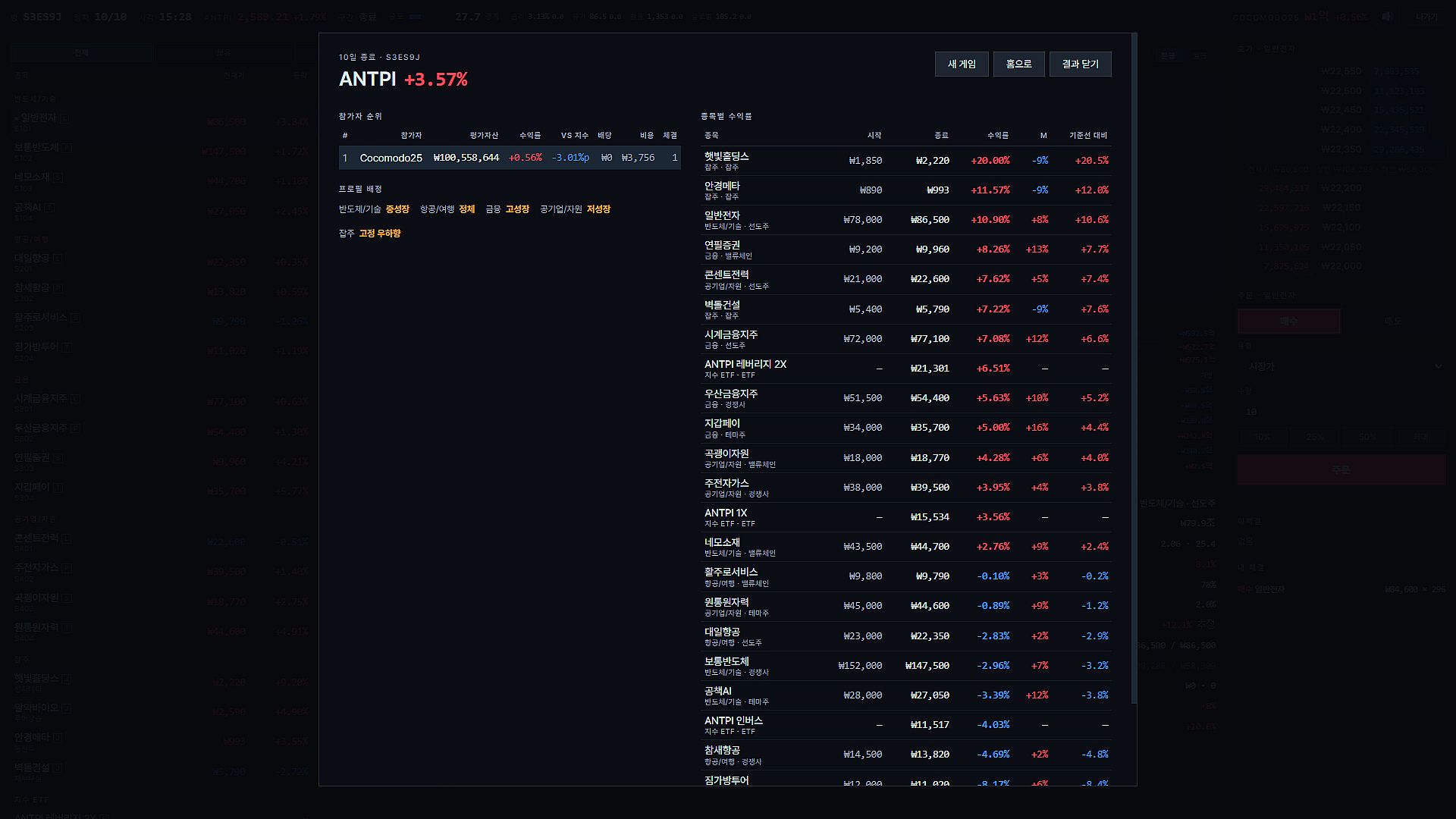
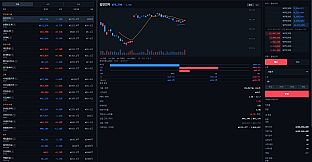
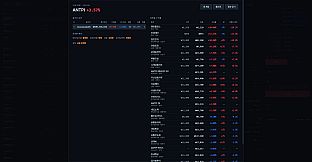
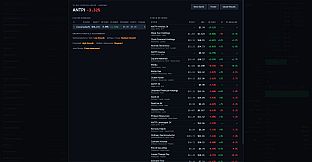
ANT SIMULATOR: stock market game is a strategy and simulation title that places players in the role of a lone retail investor, known in Korean markets as an "ant," navigating a compressed and heightened version of real-world trading dynamics. Built as a free-to-play indie experience for PC, it emphasizes survival through portfolio management, risk assessment, and adaptation to shifting market conditions rather than guaranteed profits.
Gameplay
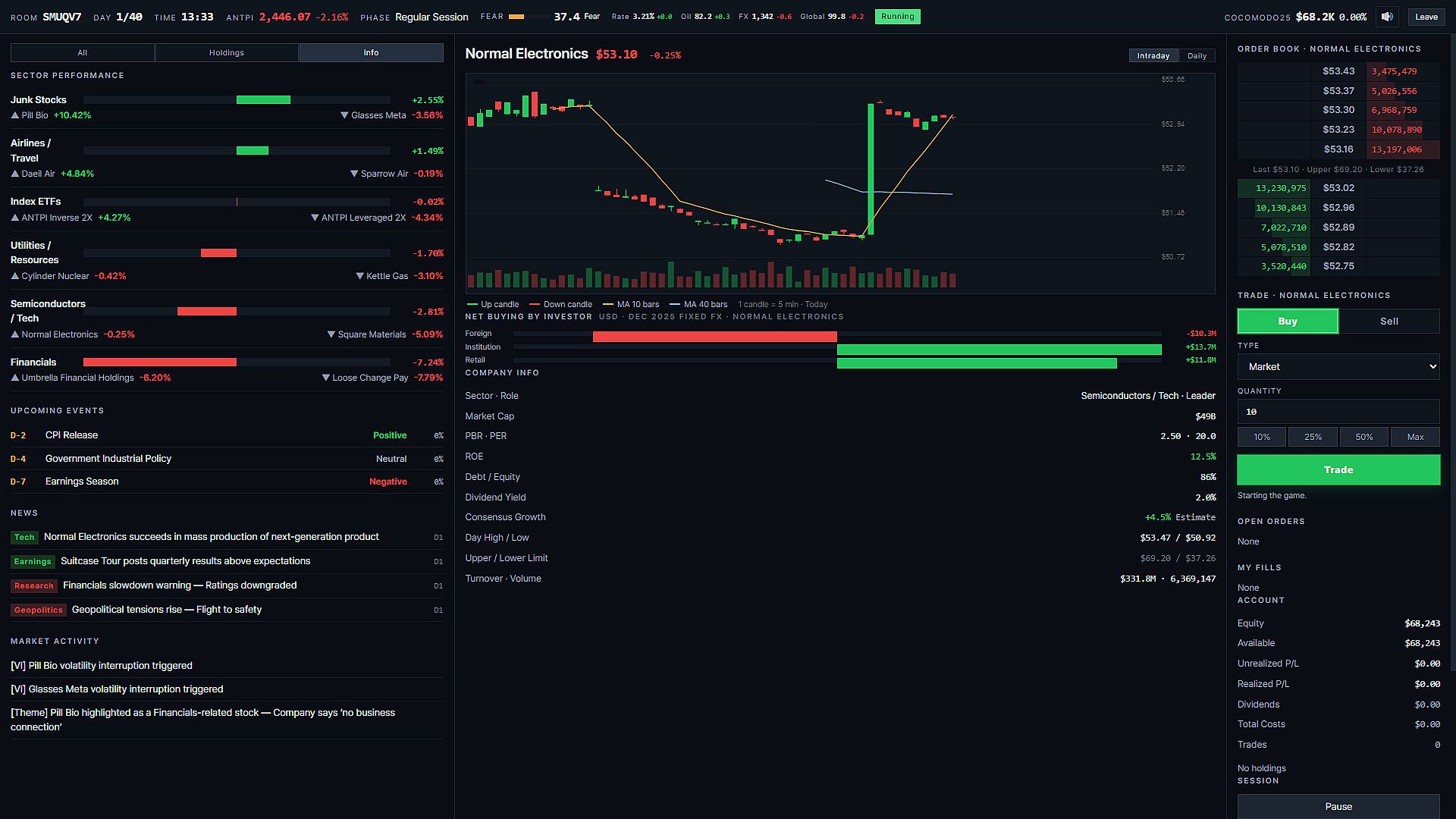
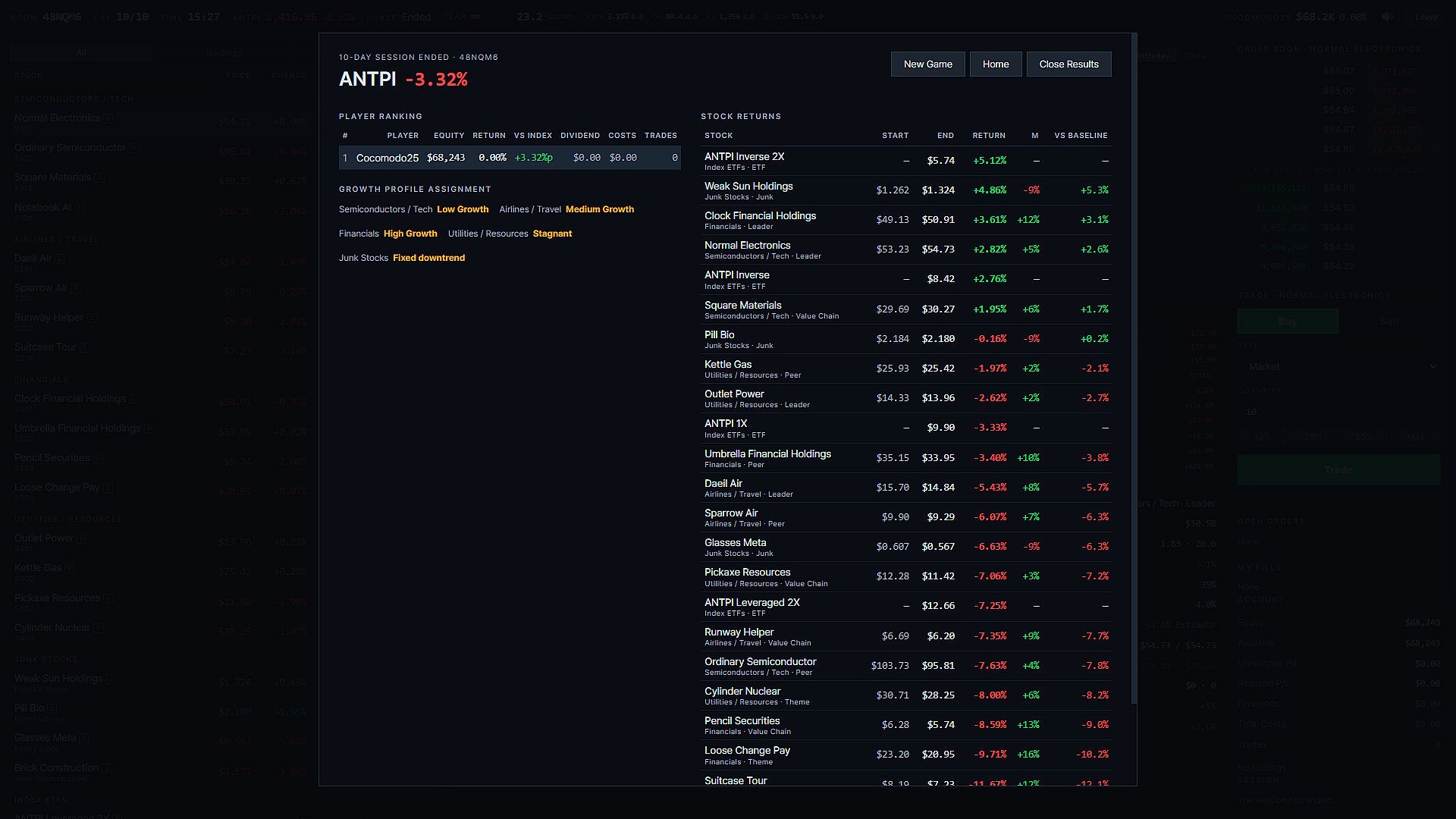
The core loop revolves around monitoring a simulated Korean stock market index called the ANTPI while making allocation decisions across various assets. Sessions unfold over short periods that represent months of real time, with deliberate amplification of price swings to deliver intense bull and bear cycles in each playthrough. Players track investor flows from retail, institutional, and foreign sources, along with corporate metrics such as PER, PBR, and ROE, though these figures arise from procedurally generated company structures.
Market mechanics include sector cycles, leading-stock movements, news-driven gaps, and momentum effects from different investor groups. Safeguards like circuit breakers, sidecars, and volatility interruptions activate during extreme swings to pause or moderate trading. Correlations between elements such as oil prices and airline stocks, or global indices and domestic performance, follow patterns observed in actual markets but operate under simplified rules for clarity. The engine produces unpredictable day-to-day results with fat-tailed return distributions, meaning calm periods dominate while occasional sharp spikes or drops occur beyond normal expectations.
Decision-making draws from multiple indicators without the delays or misinformation found in live trading. Hedging strategies and conservative portfolio balancing help weather downturns, while aggressive positions allow pursuit of high-volatility opportunities. Each run generates a fresh market trajectory, yet statistical properties across many simulations remain consistent, with final index values clustering around a predictable mean and standard deviation.
Game Modes
ANT SIMULATOR supports solo play focused entirely on individual survival and strategy refinement against the automated market forces. In this mode, the emphasis stays on personal risk management and reading macro signals without external competition.
A separate competitive option allows up to four players to participate in the same live market instance simultaneously. Participants share the identical price movements and economic events but execute independent trades, turning the session into a direct comparison of approaches under identical conditions.
Market Modeling and Realism
The simulation draws from Korean market behaviors while compressing timelines and adjusting volatility to roughly three to four times real levels for dramatic effect within brief sessions. Elements like foreign-investor momentum, institutional cycles, and retail attention patterns appear in recognizable forms, yet the full complexity of order books and external variables receives streamlining for accessibility. Global linkages, exchange rates, and commodity impacts retain directional accuracy verified through extensive Monte Carlo testing across hundreds of runs.
Procedural generation ensures no two sessions repeat exactly, even as overall distributions hold steady. The design deliberately lowers the presence of simulated retail NPCs to heighten the sense of operating alone amid larger forces. Educational intent appears through transparent mechanics that illustrate supply-demand dynamics and statistical properties without claiming predictive power for real investments.
Is It Worth Playing?
ANT SIMULATOR targets players interested in strategy simulations that blend market observation with tactical resource allocation. Its lightweight engine and focused scope suit short sessions or repeated attempts to test different risk profiles. The upcoming release on September 4, 2026, means current information rests on developer descriptions of systems and verified mechanics rather than widespread player feedback. Those drawn to educational stock market models or compact volatility experiences may find value in its approach to survival under uncertainty, particularly when exploring solo or small-group competitive formats. Availability as a free-to-play title on PC further lowers the barrier for trying its core systems once launched.