











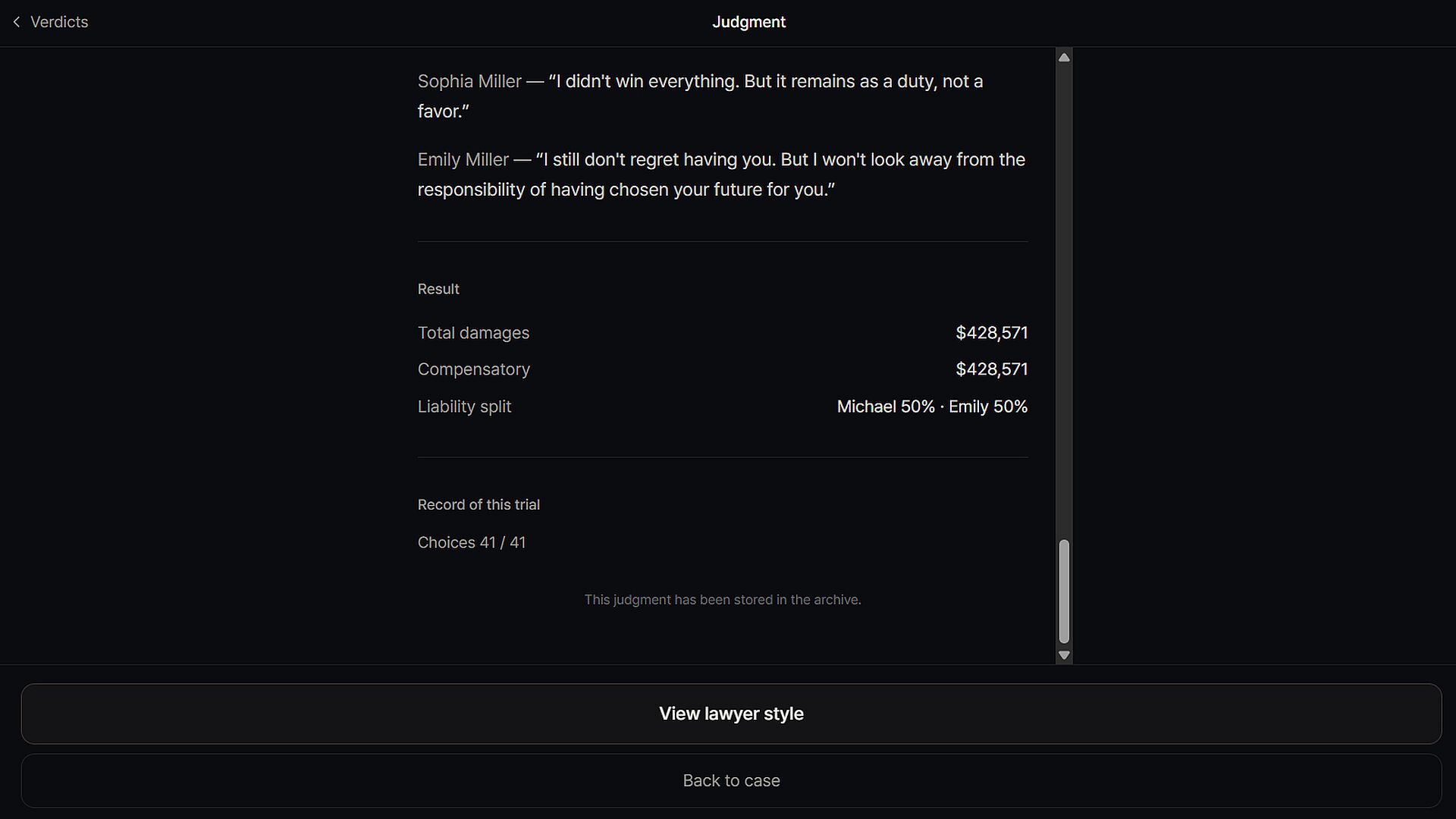





Sue Your Parents is a single-player strategy and simulation game that places players in a courtroom setting to debate one of the most absurd legal questions imaginable. The core premise treats the act of being born without consent as a serious case, letting participants argue either for or against parental responsibility in bringing a child into the world. Built as an indie title for PC, the experience emphasizes logical choices over action or narrative twists, with every decision shaping the outcome of the trial.
Gameplay
The gameplay centers on building arguments through a series of straightforward courtroom choices. Players select positions on topics like personal consent, the obligations created by parenthood, and the financial realities of raising a child. These selections influence how the case progresses, with the opposing side often using prior statements to counter the current position. The system avoids complex legal terminology, presenting ideas in clear terms that focus on everyday concepts of fairness and accountability. Each playthrough lasts a short time, designed for completion in one session, and the mechanics encourage experimentation with different lines of reasoning to see how verdicts shift.
Switching perspectives adds depth to the loop. After arguing one side, players can restart from the opposite viewpoint to challenge the same ideas they previously supported. This structure highlights contradictions in logic without requiring prior knowledge of court procedures or philosophy. The simulation elements come through in how abstract concepts like the cost of existence translate into concrete arguments that affect the final ruling.
Game Modes
The game features two primary approaches that function as opposing modes within the same core experience. In one, the player takes the role of the child suing for damages related to being brought into existence without agreement. In the other, the player defends the parents by arguing that creation itself does not impose unlimited lifelong debts. Both modes use the same choice-based system, but the available arguments and counterpoints differ based on the selected side. Different verdicts emerge depending on the consistency and strength of the positions taken during the trial. Replayability comes from testing how the court responds when the same logic is applied from the reverse perspective.
Key Mechanics and Features
Core systems revolve around responsibility, consent, and economic arguments presented in accessible language. Players question whether parents owe compensation simply for choosing to have children, or whether the benefits of life outweigh any claimed harms. The absence of murder, abuse claims, or family secrets keeps the focus narrow on the philosophical and practical issues at hand. No hidden elements or branching storylines beyond the verdict variations exist, which keeps the experience concise and replay-focused on argument outcomes rather than exploration.
Visuals and presentation support the serious treatment of the ridiculous premise through a straightforward courtroom format. The game runs on standard PC hardware with minimal requirements, emphasizing text-driven decisions over graphics or real-time elements.
Current State and Availability
As of now, Sue Your Parents remains in development with a planned release in September 2026. It supports single-player only and includes family sharing options on the platform where it will be available. No post-launch updates or additional content have been detailed yet, consistent with its status as an upcoming indie release. The title positions itself as a complete, self-contained experience without reliance on ongoing seasons or expansions.
Is It Worth Playing?
This game suits players interested in short strategy simulations that explore unconventional ideas through choice-driven arguments. Those who enjoy debating abstract concepts like consent and parental duty in a structured format will find the two-sided structure rewarding for multiple playthroughs. With no reviews available prior to release, expectations should center on the described focus on logical consistency and verdict variations rather than expansive content or multiplayer elements. It offers a clear, contained experience for anyone seeking a thoughtful yet light courtroom simulation without dense terminology or extended commitments. If the premise of treating existence itself as a legal matter appeals, the game delivers exactly that in a focused package.











